
Largo FL Concrete Foundations: Sandy Soil Guide
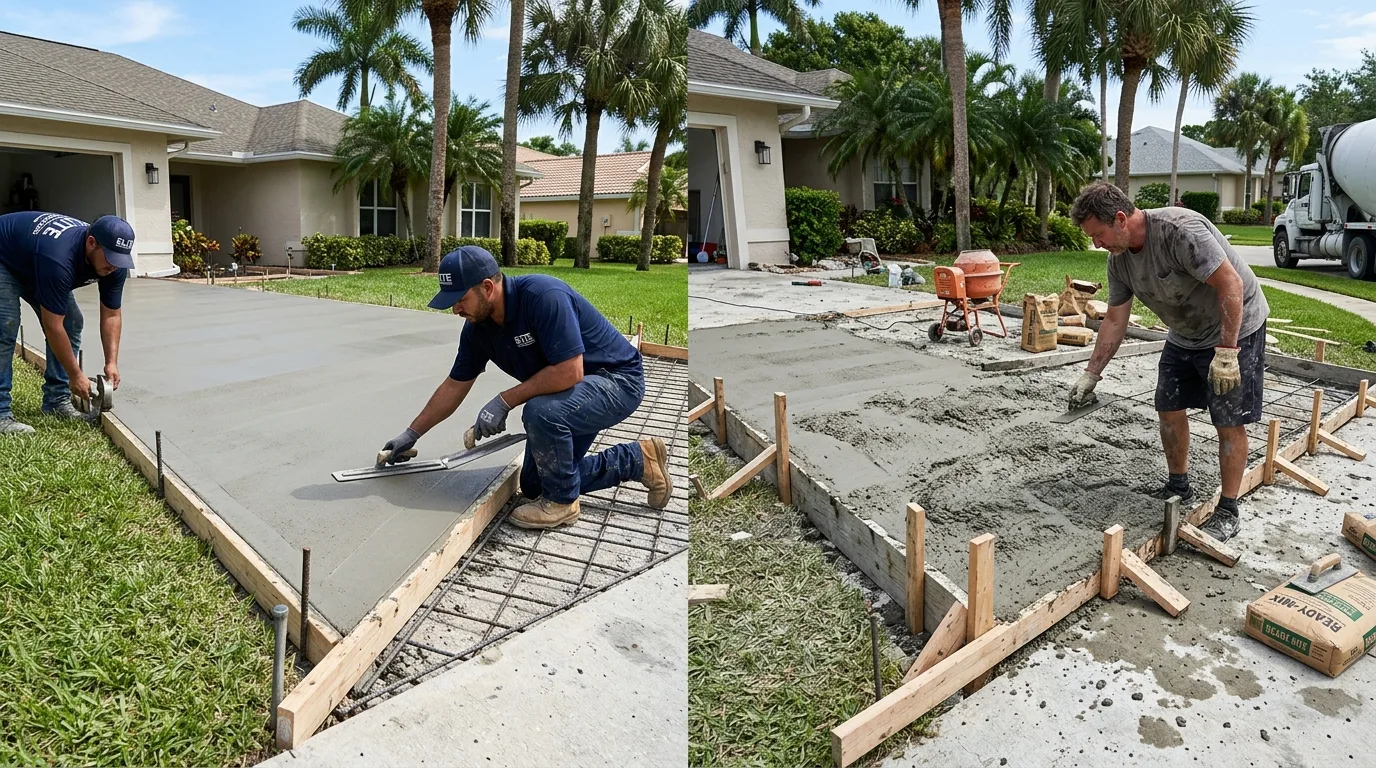
The question most Largo homeowners don’t think to ask until something goes wrong: what does my concrete slab actually sit on, and is it built correctly for Pinellas County’s conditions? Florida’s sandy soils and high water table make foundation and slab design more critical than in most US markets — and the consequences of getting it wrong show up years or decades after the pour, long after the original contractor is gone.
In this post, we cover how concrete foundations and slabs are designed for Largo’s sandy soil conditions, what the Florida Building Code requires, and how vapor barriers protect structures from Pinellas County’s high water table. For overall Largo concrete costs, see our 2026 concrete pricing guide.
Planning a Concrete Slab or Foundation in Largo?
We design for Pinellas County's soil and water table conditions. Call (888) 376-0955.
Why Largo’s Sandy Soil Changes Everything About Slab Design
Sandy soils have one defining characteristic that affects every concrete pour in Largo: they have low cohesion. Individual sand particles don’t bind to each other the way clay particles do, which means sandy subgrade has limited inherent load-bearing capacity and consolidates readily under applied loads. A concrete slab poured directly on loose sandy subgrade — without proper compaction or base rock — will settle as the particles rearrange under the slab’s weight and the cyclic loads of vehicles or building structure above it.
The rate of settlement isn’t uniform. Sandy subgrade settles more under load concentration points (column footings, vehicle tire tracks on driveways) than under lightly loaded areas. This differential settlement is what causes the cracking patterns familiar in Largo — diagonal cracks near driveway edges, cracks radiating from interior supports, sections of floor slabs that dip in the center. These aren’t random events; they’re predictable outcomes of inadequate base preparation under Largo’s sandy conditions.
The good news: sandy soil compacts well when properly prepared. With adequate compaction in lifts (4–6 inch layers, each compacted before the next is placed) and with base rock installed beneath the concrete, sandy subgrade in Largo performs comparably to more cohesive soils. The Florida Building Code Chapter 18 codifies soil preparation requirements specifically because Florida’s variable sandy soils demand a site-specific approach rather than assuming native soil is adequate.
Types of Options: Foundation and Slab Systems for Largo
Slab-on-Grade: The most common foundation type in Largo and throughout Pinellas County. A concrete slab poured directly on prepared and compacted subgrade, typically 4–6 inches thick with a reinforced perimeter grade beam and interior reinforcement (fiber mesh or rebar depending on load). Correctly designed, slab-on-grade is appropriate for most residential and commercial construction in Largo’s conditions.
Monolithic Slab: A slab-on-grade variant where the slab and perimeter footings are poured as one continuous unit. Common in Florida new construction. The thickened perimeter section provides edge beam resistance. For garage additions and smaller structures in Largo, monolithic slabs are the typical approach.
Stem Wall Foundation: For applications where a raised floor is desired or where soil conditions require it, concrete stem walls (short vertical walls above the footing) raise the floor framing above grade. More expensive than slab-on-grade but allows for crawl space access and elevated first-floor elevation — a consideration in Largo’s flood-prone low areas.
Pile and Grade Beam: For soft or loose sandy areas in Largo where standard slab-on-grade would require impractical amounts of fill to reach stable soil, driven piles or drilled piers can extend to competent bearing strata. This approach is more common near the Intracoastal in Harbor Bluffs and Anona, where fill soils over organic layers may be encountered.
Practical Uses: What These Soil Facts Mean for Your Largo Project
- When adding a garage slab: Specify minimum 6 inches of compacted base rock beneath the concrete. A garage slab in Largo without adequate base rock under the sandy subgrade will develop center-span settling within 10–15 years under regular vehicle traffic.
- When building a shed foundation: Even a simple 10×12 ft shed slab benefits from proper base preparation. Sandy subgrade under a shed slab that isn’t compacted will settle unevenly as the structure loads different points of the slab over time.
- When getting a concrete quote: Ask explicitly: What depth of base material are you specifying? What compaction standard will you achieve? A contractor who can’t answer these questions specifically hasn’t done their soil assessment homework.
- For pool equipment pads: Concrete utility pads for HVAC equipment, pool pumps, and generators require stable bases — equipment vibration accelerates settlement in uncompacted sandy soil.
- Before any pour near the water table: In low-lying sections of Walsingham and areas near Eagle Lake Park, the water table can be within 2–3 feet of grade. A geotechnical assessment before large foundation pours in these areas is prudent.
- For understanding vapor barriers: The continuous 6-mil vapor barrier beneath any slab in Largo is non-negotiable given the high water table — not just code-required but functionally essential for preventing moisture migration into garages, utility buildings, and home additions.
How the Vapor Barrier Protects Largo Slabs
Pinellas County’s high water table is the defining moisture condition for Largo concrete. During Florida’s wet season (June through September), the water table rises — sometimes to within a few feet of grade in lower-lying neighborhoods. Ground moisture migrates upward through capillary action in sandy soil, passing through inadequately protected slabs and into the structure above. The consequences range from damp floors and mold conditions to structural damage in wood framing systems built on slab foundations.
A continuous 6-mil polyethylene vapor barrier installed over the compacted base and base rock creates an impermeable membrane that stops capillary moisture migration before it reaches the concrete. This is required by Florida Building Code for any conditioned space, but we install vapor barriers on all slabs — including garages and utility structures — because Pinellas County’s water table makes it the right practice regardless of whether it’s required for the specific application.
In Largo’s Harbor Bluffs and Anona neighborhoods, where proximity to the Intracoastal means elevated moisture conditions, we use heavier vapor barriers (10-mil in some applications) and ensure that the slab is set sufficiently above finished grade to prevent surface water intrusion at the slab edge during high water table periods.
Concrete Slabs Built for Largo's Soil Conditions
We specify base prep and vapor barriers correctly for Pinellas County. Call (888) 376-0955 for a free estimate.
Cost Factors for Concrete Foundations in Largo
The primary variable in Largo foundation and slab pricing is how much base material is needed to compensate for soft or inadequate native soil. Sites with firm, well-drained native sandy soils may require only 4 inches of compacted base rock. Sites with soft fill soil, organic material, or proximity to the water table may require 6–8 inches of base rock plus subgrade stabilization — adding $0.50–$2.00/sqft to the base preparation cost.
Standard concrete slabs in Largo run $6–$10/sqft for 4-inch pours. Slabs with additional base rock, thicker sections, or rebar reinforcement for heavy loads run $8–$12/sqft. For foundation applications involving stem walls or grade beams, additional forming and concrete costs apply. We assess sub-base conditions at every site before specifying the base prep approach — the site conditions determine the specification, not a one-size-fits-all formula.
Frequently Asked Questions
Does Largo FL have foundation problems due to sandy soil?
Largo and Pinellas County do see foundation and slab issues related to sandy soil — but they’re almost always attributable to inadequate original base preparation, not to the sandy soil itself. Sandy soil, properly compacted with adequate base rock and vapor barrier, is a fully adequate foundation material. The problems arise when these preparation steps are skipped in the original construction. Most foundation and slab issues we repair in Largo trace to inadequate base preparation, not to soil conditions that couldn’t be managed.
Does the Florida Building Code require soil testing before a slab?
The 8th Edition Florida Building Code Chapter 18 requires soil evaluation for structural foundations. For standard residential slabs (patios, driveways, utility pads), formal soil testing is not typically required. For structural foundation slabs supporting habitable space, soil bearing capacity should be considered. We assess visual soil conditions at every site and recommend additional evaluation when site conditions suggest it.
How deep does a concrete slab need to be in Largo?
Standard residential slabs in Largo are 4 inches thick with fiber mesh reinforcement. Vehicle-bearing slabs (garages, driveways, commercial surfaces) are 5–6 inches with rebar. Foundation slabs with perimeter grade beams for habitable additions follow Florida Building Code requirements, typically 4 inches at the slab with a thickened 12–18 inch perimeter beam. The concrete depth specification should be driven by the intended load, not a budget-minimum.
Related: