
Largo FL: Concrete Repair vs. Replacement — The Guide
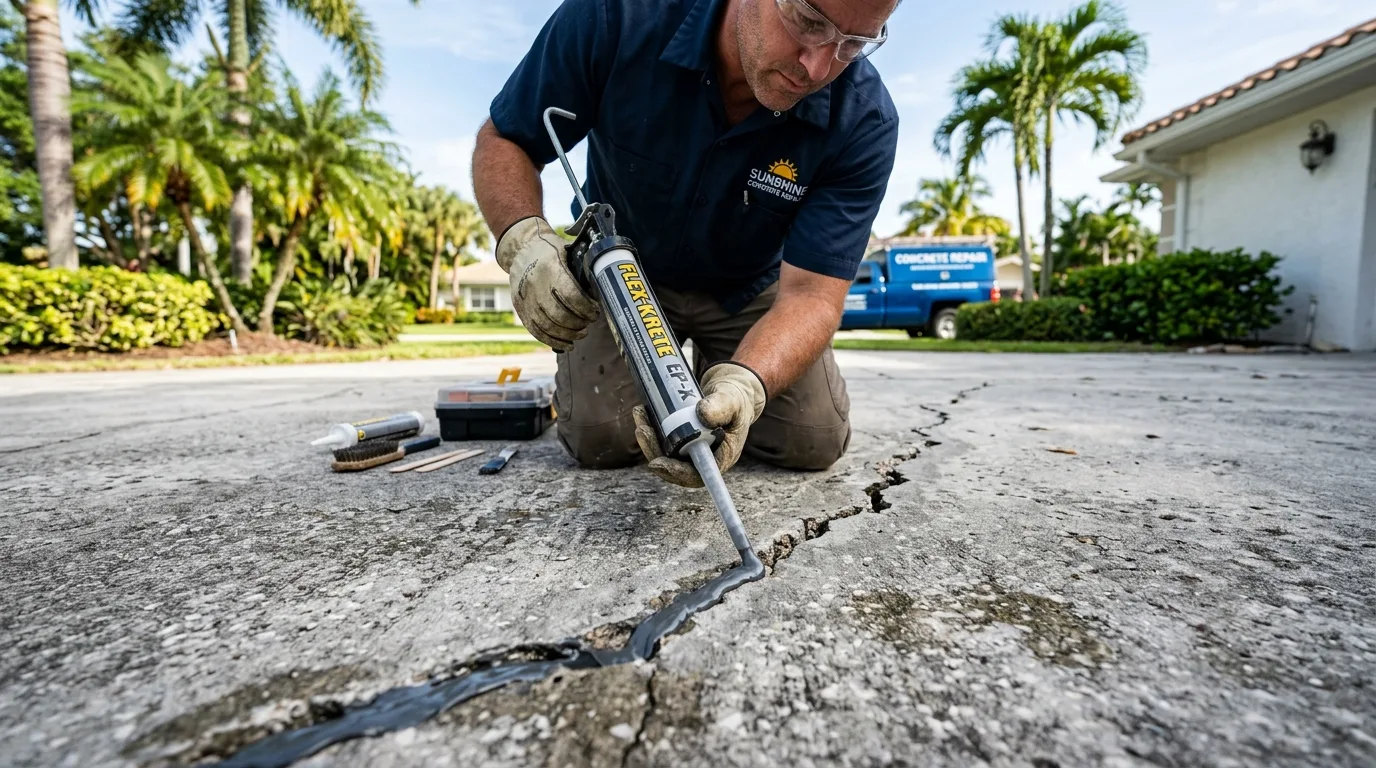
Repair or replace? It’s the question Largo homeowners wrestle with every time cracked, spalled, or settled concrete becomes obvious enough to act on. The challenge is that the wrong answer costs you money either way — repair money wasted on concrete that needed replacement, or replacement cost incurred unnecessarily when repair would have delivered another decade of service.
In this post, we give you a clear decision framework for concrete repair vs. replacement in Largo, FL — based on the factors that actually determine the right answer for Pinellas County conditions. See also: 5 signs your Largo driveway needs replacing.
Not Sure If Your Largo Concrete Needs Repair or Replacement?
Free, honest assessment with no upsell agenda. Call (888) 376-0955.
Why the Repair vs. Replacement Decision Is Harder in Largo
The correct repair vs. replacement decision always hinges on whether the damage is surface-level (and the underlying structure is sound) or whether the structure itself is compromised. In most markets, this is relatively straightforward to assess. In Largo, Pinellas County’s sandy soils add a layer of complexity: sub-base erosion — which drives structural failure — can be significant without being obvious from the surface. Our concrete foundations guide covers how Largo’s soil conditions affect slab longevity.
A slab in Largo that looks like it has surface-level cracking may have voids beneath it from years of water channeling through the sandy subgrade. Those voids mean the slab is unsupported, and repair applied to the surface will fail as the unsupported sections flex and re-crack. The only way to know is a proper assessment that includes sound testing (tapping the slab to listen for hollow sections) and evaluation of drainage patterns that could indicate sub-base erosion.
This is why our assessments are free and unhurried — because the right recommendation requires actually evaluating the specific slab, not quoting from a photo.
Types of Options: Repair Approaches for Largo Concrete
Crack Filling: Flexible polyurethane or epoxy injected into cracks to stop water infiltration and prevent widening. Appropriate for cracks under 1/4” that are stable (not widening seasonally). Cost: $3–$7 per linear foot. Expected life: 5–15 years if the underlying cause (drainage) is also addressed.
Spall Patch Repair: Polymer-modified mortar applied to areas where the concrete surface layer has broken away. Appropriate for spalling confined to the top layer, not extending through the full slab depth. Cost: $5–$15/sqft depending on depth and area. Expected life: 5–15 years.
Resurfacing Overlay: A thin bonded overlay applied across the entire slab surface. Restores appearance and texture uniformly. Appropriate when surface deterioration is widespread but the slab is structurally sound. Cost: $7–$12/sqft. Expected life: 8–15 years.
Mudjacking: Pumping a grout mixture beneath a settled slab to lift it back to grade. Appropriate for settled sections over sound sub-base. Not appropriate when the sub-base itself has eroded or lost bearing capacity. Cost: $500–$1,500 per section. Expected life: 5–15 years.
Full Replacement: Demolition of the existing slab, correction of sub-base conditions, and new pour. The only option when the slab is structurally compromised throughout. Provides full longevity reset — 30–50 years on a properly built new slab.
Practical Uses: Applying the Decision Framework
- Hairline to 1/4” stable cracks: Repair — crack fill plus sealing is appropriate if cracks aren’t widening and the sub-base shows no signs of erosion. Monitor after the first wet season.
- Cracks over 1/4” that have widened over the past 2 wet seasons: Likely replacement — the sub-base is eroding and repair materials won’t hold. Get an assessment.
- Surface spalling under 10% of area: Repair — spall patch plus resealing is cost-effective when the rest of the surface is in good condition.
- Surface spalling over 25% of area on a 20+ year old slab in Walsingham or Del Prado: Likely replacement — the concrete mix has degraded throughout, and patching a quarter of the surface is expensive relative to replacement.
- Sections settled 1/2” with sound slab otherwise: Mudjacking may work — assess sub-base condition and drainage before deciding.
- Sections settled more than 1” with drainage failure toward the foundation: Replacement — mudjacking without fixing drainage fails within 3–5 years.
- 35+ year old slab with widespread damage: Replacement — the concrete is at end of service life and repair costs will compound over the next decade.
How to Evaluate Your Specific Situation in Largo
The repair vs. replacement decision depends on four specific variables that require on-site assessment:
Sub-base condition: Tap concrete sections with a heavy screwdriver — hollow sound means void beneath. Visible erosion channels, water staining at cracks, and sections that rock or flex underfoot all indicate sub-base compromise.
Drainage: Watch where water goes after Largo’s afternoon thunderstorms. Water pooling on the slab or channeling under it points toward drainage correction as part of any solution.
Age and original installation quality: Pre-1990s concrete in Largo was typically poured thinner (3–3.5 inches) without reinforcement. These slabs have more limited remaining repair value than properly specified newer slabs.
Damage extent and distribution: Isolated damage on an otherwise sound slab — repair. Widespread damage throughout — replacement. Mixed — assess section by section with realistic repair life estimates.
Free Repair vs. Replacement Assessment for Largo Homeowners
We give you an honest recommendation — not the one that generates the biggest invoice. Call (888) 376-0955.
Cost Factors in the Repair vs. Replacement Decision
The break-even point between repair and replacement in Largo typically falls when repair cost approaches 50–60% of replacement cost. If replacement is $4,000 and comprehensive repair is $2,500, the repair typically makes sense if it will deliver 8–12 years of service. If repair is $3,200 and replacement is $4,000, replacement provides much better value — particularly when the new slab starts a 30-year clock on properly built concrete.
The calculation also includes future repair costs. A slab that needs $2,000 in repairs now may need another $1,500 in two years if the underlying cause isn’t resolved. Total 5-year repair cost of $3,500+ often exceeds replacement cost — and the replacement option delivers a new slab at the end of it.
Frequently Asked Questions
How honest will a contractor be about repair vs. replacement?
A contractor who only does replacement will recommend replacement. A contractor who only does repair will recommend repair. The most reliable assessment comes from a contractor who performs both services and prices them honestly. Ask directly: If this were your driveway or patio, what would you do? And why? The answer — and the reasoning — tells you what you need to know about the contractor’s honesty.
Can I fix the drainage problem without replacing the concrete?
Sometimes — surface grading corrections adjacent to the slab can redirect water away from the problem area without touching the concrete. French drain installation along the slab perimeter is another option for properties in Pinellas County where water channels alongside concrete. But when the drainage failure is directing water under the slab, the only real fix is excavating the slab edge, correcting the sub-base and drainage, and replacing the affected section.
What about resurfacing as a middle option?
Resurfacing (applying a new surface layer over existing concrete) is a legitimate middle option when the slab is structurally sound but the surface is uniformly worn. It doesn’t address cracks, structural issues, or drainage. In Largo, resurfacing is most appropriate for pool decks and patios that have surface wear but no structural compromise. For driveways with active cracking or settlement, resurfacing is typically a temporary cosmetic fix rather than a real solution.
Related: