
5 Signs Your Largo Concrete Driveway Needs Replacing
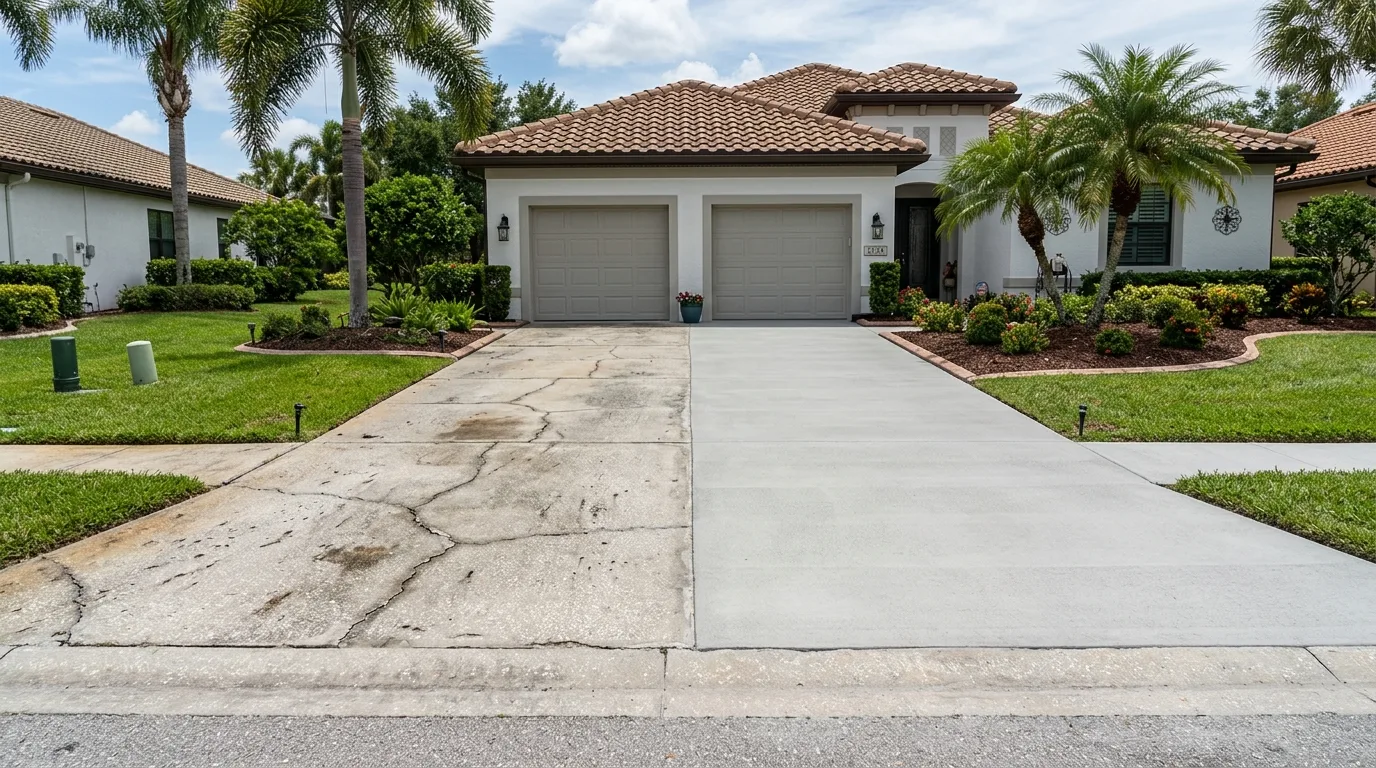
Concrete driveways in Largo, FL age in predictable patterns — and knowing when repair is still the right call versus when replacement is actually the smarter investment can save you thousands of dollars in patched repairs that fail anyway. Most Largo homeowners wait until the damage is severe and obvious before calling anyone. The warning signs that replacement is coming often appear years before the driveway becomes dangerous or completely unusable.
In this post, we cover the five specific signs that indicate replacement (not repair) is the correct answer for your Largo concrete driveway, and explain why Pinellas County’s conditions make each sign more significant than it might be in other markets.
Not Sure If Your Largo Driveway Needs Repair or Replacement?
Free, honest assessment — we tell you what it actually needs. Call (888) 376-0955.
Why This Matters for Largo Homeowners
Repairing a driveway that needs replacement is one of the most common and expensive mistakes Largo homeowners make — not because concrete repair itself is wrong, but because repair money spent on a driveway at the end of its service life doesn’t extend that life. It just delays replacement while adding to the total cost. Conversely, replacing a driveway that could have been repaired for a few hundred dollars is wasteful if the underlying structure is still sound.
The determining factor is always the sub-base condition under the slab. Largo’s sandy soils and high water table create conditions where sub-base erosion accelerates slab failure faster than in other Florida markets. A driveway on a compromised sub-base will fail again after repair — often within two to three years. A driveway on a sound base can frequently be repaired and extended for another decade. Our free assessments evaluate both the surface condition and what’s happening underneath before recommending repair or replacement. See our full repair vs. replacement guide for the complete decision framework.
Sign 1: Multiple Full-Depth Cracks Across the Slab
Surface hairline cracks are normal in concrete and typically a sealing and monitoring issue, not a replacement indicator. The replacement signal is cracks that have propagated through the full depth of the slab — typically visible as wide, irregular cracks where you can see separation between sections, or areas where the slab has shifted relative to the adjacent section.
In Largo, full-depth cracking often follows a wet season in which sub-base erosion advanced significantly. The pattern is visible: cracks that were surface-only in spring become full-depth splits by fall as saturated sandy subgrade beneath the slab collapses during and after heavy rain. If you’re counting more than three or four full-depth cracks on a two-car driveway, and they’ve appeared or widened within the last two to three wet seasons, replacement is likely more cost-effective than repair.
Sign 2: Significant Settlement or Heaving
A driveway that has settled unevenly — where sections have dropped or risen relative to each other by more than an inch — indicates sub-base failure. The most common cause in Largo is sandy subgrade erosion under the slab, either from poor original compaction or from drainage failures that have channeled water beneath the concrete over many years.
Mudjacking can stabilize settled sections in some cases, but it’s a temporary fix if the drainage problem causing the erosion isn’t also corrected. In established Largo neighborhoods like Walsingham, where drainage has sometimes directed water under concrete for decades, mudjacking followed by replacement within 5–7 years is common. If settlement is more than an inch across multiple sections, a replacement with corrected drainage design is typically the better long-term investment.
Sign 3: Surface Spalling Across More Than 25% of the Area
Surface spalling — where the top layer of concrete is breaking away in chips, revealing aggregate underneath — is a sign of concrete paste deterioration. In Largo, the causes are almost always UV degradation from inadequate sealing over years, or water infiltration followed by the Florida wet/dry cycle weakening the cement paste. When spalling covers a small area (under 10%), resurfacing or spall patch repair is cost-effective. When spalling covers more than a quarter of the driveway surface, especially on a slab that’s already 20+ years old, the economics shift toward replacement.
The reason: extensive spalling typically indicates that the concrete mix has degraded throughout — not just on the surface. Patching 25% of a spalled surface often means the other 75% will require patching within the next few years as the degradation continues. On a 400-square-foot driveway in Largo, widespread spalling repair can approach $1,500–$3,000 — at which point replacement at $3,200–$6,000 becomes the better investment with a 30-year return.
Sign 4: Drainage That Directs Water Toward the Foundation
A concrete driveway that slopes toward the house rather than away from it isn’t a surface repair problem — it’s a design and installation failure that requires replacement to correct. Water directed toward the foundation contributes to moisture infiltration, slab heaving near the structure, and long-term foundation problems.
In Largo, this issue is most common on older driveways installed before current slope requirements, and on driveways where grade changes around the property have altered original drainage patterns. Patching or resurfacing a driveway with this slope problem doesn’t fix the drainage — only replacement with corrected grade design does. If your driveway actively channels water toward your garage or foundation after Largo’s summer afternoon thunderstorms, replacement with proper slope is the only real solution.
Sign 5: More Than 30 Years Old With Widespread Damage
Concrete driveways in Largo that were installed before the mid-1990s were typically poured thinner (often 3–3.5 inches rather than today’s standard 4 inches), without fiber mesh reinforcement, and often without adequate base preparation by current standards. A 35-year-old Largo driveway showing widespread cracking is simply at the end of its practical service life — its structural condition reflects both the age and the lower original installation standards.
At this point, the question isn’t whether to replace but when. Multiple repair sessions on a 35-year-old slab in Largo’s climate typically become more expensive over five years than a single replacement that starts the clock on a new 30–40 year lifespan. The older the slab, the less value repair adds relative to replacement cost.
Get a Free Driveway Replacement Assessment in Largo
We'll tell you honestly whether repair or replacement is the right call — no upsell. Call (888) 376-0955.
Practical Uses for Applying These Signs
- Before calling anyone: Walk your driveway and photograph every crack, spalled area, and settled section. This documentation helps the contractor assess condition before arriving, speeds up the estimate, and establishes a baseline if you’re monitoring change over time.
- After a wet season: Largo’s June–September rainy season often accelerates sub-base erosion — signs that were marginal in spring can advance significantly by October. Assess your driveway at the start of the dry season each year.
- Before selling your home: A driveway in replacement territory is often flagged in buyer inspections and can become a negotiation point. Addressing it proactively gives you control over the contractor, timeline, and finish choice.
- When comparing repair quotes: If a contractor proposes extensive repair on a driveway showing multiple replacement signs, ask directly: Will this repair resolve the underlying cause, or will I be back in 3 years? A contractor who answers honestly that replacement is the better value is one worth working with.
- HOA compliance: Some Largo HOA communities have standards for driveway condition. Driveways showing multiple signs may trigger HOA maintenance notices — replacement addresses all issues simultaneously.
Frequently Asked Questions
Can tree roots be removed before replacement in Largo?
Yes — and they should be. Tree root removal and installation of a root barrier before the new concrete pour is standard practice in Largo neighborhoods with mature oaks and other large trees. The barrier prevents root regrowth under the new slab. In Walsingham and Del Prado, where mature street trees are common, this is a routine part of driveway replacement.
How long will a new concrete driveway last in Largo?
A properly installed concrete driveway in Largo — with adequate base preparation, vapor barrier, appropriate reinforcement, and regular sealing — will last 30–50 years. Florida’s lack of freeze-thaw cycling means the primary maintenance factors are sealing (every 2–3 years) and prompt crack repair when small cracks appear. The new slab will outlast the original if installed to current standards.
Can I keep part of my driveway and replace just the damaged sections?
Partial replacement is appropriate when the rest of the slab is genuinely in good condition — not just marginally acceptable. If more than two or three sections need replacement, full replacement is often better economics and provides a uniform new surface. Partial replacement with different age concrete can cause visible seam lines and doesn’t address sub-base conditions under the preserved sections.
Related: