
Largo FL Concrete Walkway Installation: Full Guide
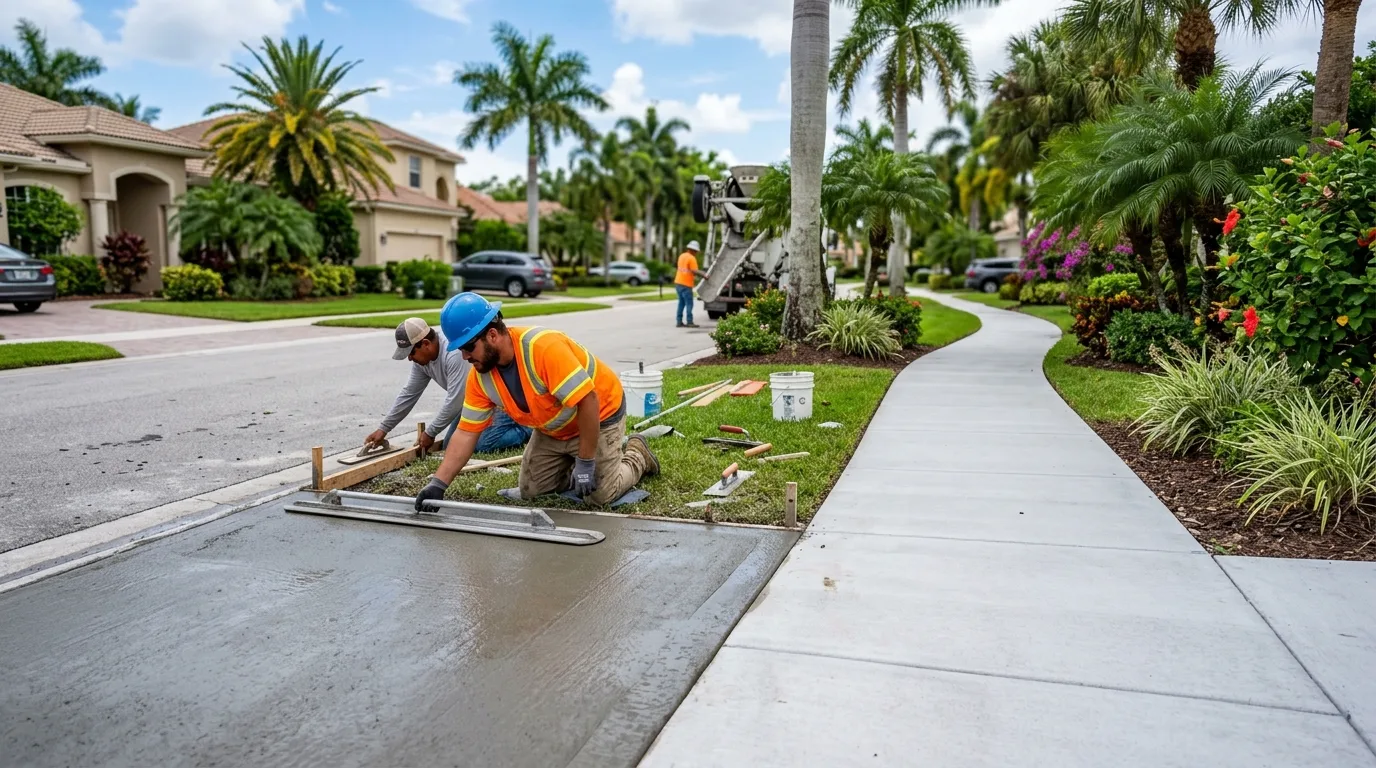
A well-designed concrete walkway improves your property’s functionality, curb appeal, and safety — and in Largo’s year-round outdoor climate, a path that connects your front door to the driveway, backyard to the pool, or side yard to the gate gets daily use twelve months a year. The challenge for Largo homeowners is understanding what makes a walkway last versus one that cracks and crumbles within five years, which is a real distinction when you’re working with Pinellas County’s sandy soil and Florida’s climate.
In this post, we cover the concrete walkway installation process, the finish options available in Largo, permit requirements, and the specific conditions that affect walkway design in Pinellas County. For related services, see concrete patio contractors in Largo.
Get a Free Concrete Walkway Estimate in Largo
Front walks, garden paths, and side-yard concrete throughout Pinellas County. Call (888) 376-0955.
Why Concrete Walkways Outlast Other Options in Largo
Concrete outperforms pavers, stepping stones, and gravel for Largo residential walkways in the long run because it’s a continuous surface without joints to shift, weeds to grow through, or individual units to settle unevenly on sandy subgrade. See our stamped concrete vs. pavers comparison for more detail on this tradeoff. In Del Prado and Walsingham neighborhoods where mature tree roots are common, individual paver walkways buckle and displace as root systems grow — concrete sections do the same, but section repair is simpler and the surface remains more uniform between repairs.
Florida’s afternoon thunderstorms also favor concrete: a well-graded concrete walkway handles heavy rainfall without erosion or displacement of individual units. Sandy subgrade under a stepping stone path erodes over time, causing stones to sink and tilt; concrete over properly compacted sandy subgrade in Largo maintains its level and slope through years of wet seasons.
The main alternative — natural stone or travertine pavers — looks beautiful and provides premium aesthetics, but requires more maintenance (joint sand, weed control, individual unit releveling) and costs significantly more than concrete. For most functional walkway applications in Largo, concrete delivers the best durability-to-cost ratio.
Types of Concrete Walkway Finishes
Broom Finish ($8–$12/sqft): A broom pulled across the surface creates a textured, slip-resistant finish — the standard and most economical walkway surface. Appropriate for functional side-yard paths, garden access routes, and utility connections. With sealer, broom-finish walkways look clean and hold up for 20–30 years in Largo.
Exposed Aggregate ($10–$14/sqft): Surface aggregate is exposed by washing the concrete before full cure. Provides a natural, textured look with excellent traction in wet conditions. Popular for pool-to-house walkways and backyard paths where slip resistance on wet surfaces is a priority. The aggregate type can be selected — river rock, quartz, colored aggregate — for varying visual textures.
Stamped Walkway ($14–$20/sqft): Stamped concrete walkways with flagstone, cobblestone, or brick patterns add significant curb appeal to front entries and garden paths. In Collins Estates and Harbor Bluffs, stamped concrete front walks that complement the driveway and patio create a cohesive outdoor hardscape that elevates property value meaningfully.
Brushed Concrete with Decorative Border: Standard broom-finish interior with a smooth or stamped border accent. A cost-effective way to add visual interest to a functional walkway without the full cost of stamped concrete throughout.
Practical Uses: Planning Your Largo Concrete Walkway
- Front entry walkways: Minimum 3–4 ft wide for front door access. Consider a wider welcome walk (4–5 ft) for higher-traffic entries in a home that entertains regularly.
- Side-yard access paths: 2–3 ft wide for utility access. Wider if the path doubles as a vehicle or equipment access route.
- Backyard to pool path: Exposed aggregate or broom finish for maximum wet-surface traction. Width should accommodate two people walking side by side (4–5 ft) if the pool area is regularly used for entertaining.
- Garden and landscape paths: Narrower walkways (2–3 ft) with a flagstone-pattern stamp create a naturalistic look that blends with Largo’s garden aesthetic without requiring weed control between paver joints.
- Connecting patio to driveway: Match the patio finish for visual continuity — stamped walkway connecting to a stamped patio, or broom-finish walkway if the patio is plain.
- Replacing deteriorated stepping stones in Walsingham: Continuous concrete walkways are a straightforward upgrade from individual stepping stones that have settled unevenly in sandy subgrade.
How Largo’s Conditions Affect Walkway Design
The two Largo-specific considerations for walkway installation are drainage and root proximity. Walkways must be sloped away from structures and toward landscape areas — not back toward the house or toward neighboring properties where drainage concentration causes issues. In Pinellas County’s wet season, even a 1% slope on a concrete surface can make a significant difference in how water evacuates after thunderstorms.
Root proximity is the other design factor. In established Largo neighborhoods with mature oaks, magnolias, and other large trees, concrete walkways installed within 5–10 feet of significant trees carry real risk of root heaving over 10–15 years. Options for managing this: increased concrete thickness and reinforcement near root zones (provides more resistance to uplift), root barriers installed before the pour, or designing the walkway path to route around root zones where possible. We assess root proximity at every walkway site before pouring.
For walkways that run along the side of the house in coastal Largo neighborhoods like Anona, salt air exposure is a factor in sealer selection. Standard acrylic sealers degrade faster in coastal conditions — we use coastal-grade formulations that extend sealer life and reduce reapplication frequency.
Pinellas County’s climate also means that summer walkway installation requires the same considerations as any concrete pour in Largo: early morning starts, evaporation retardants on hot days, and weather monitoring for afternoon thunderstorms during June through September.
Concrete Walkway Installation Across Largo and Pinellas County
Broom finish, exposed aggregate, and stamped options. Call (888) 376-0955 for a free estimate.
Cost Factors for Concrete Walkways in Largo
Walkway cost is driven by linear footage and width: a 3-ft wide walkway at $10/sqft runs $30/linear foot. A 40-foot front walk in standard broom finish costs $1,200–$1,600; the same walk in stamped concrete runs $1,680–$2,400.
Additional cost factors: demolition of existing stepping stones or old walkway concrete (typically $1–$3/sqft), tree root removal and root barrier installation, drainage corrections if grade changes are required, and coastal sealer for properties near the Intracoastal. Longer or curved walkways have slightly higher form work costs than straight runs.
Permit requirements for residential concrete walkways in Largo: small walkways under 100 sq ft may qualify for a Development Review clearance; larger installations may require a standard residential building permit through the Largo Civic Access Portal. Work within the public right-of-way (front sidewalk, driveway apron approach) requires a Right-of-Way Utilization Permit from Pinellas County.
Frequently Asked Questions
How wide should a concrete walkway be in Largo?
Front entry walkways should be 3–5 ft wide — 3 ft is the minimum for comfortable single-file walking; 4–5 ft is better for front entries that see visitors regularly. Side-yard utility paths can be 2–3 ft. ADA-accessible pathways require a minimum 36 inches clear width, with 48–60 inches preferred for wheelchair maneuverability.
How long does a concrete walkway last in Largo FL?
A properly installed concrete walkway in Largo — correct base preparation, adequate slope, UV-stable sealer — lasts 20–30+ years. The Florida climate is gentle on concrete (no freeze-thaw cycling) and the main aging factors are UV exposure and root intrusion in tree-proximate locations. Regular sealing every 2–3 years is the primary maintenance requirement.
Can I install a concrete walkway in my backyard without a permit in Largo?
Small backyard walkways (under 100 sq ft) in the City of Largo may qualify for a Development Review clearance rather than a full building permit. Larger installations require a residential building permit through the Largo Civic Access Portal. Work within any Pinellas County right-of-way always requires a Right-of-Way permit. We advise on permit requirements for your specific walkway project during the free estimate.
Related: