
Largo FL Retaining Wall Options: What Homeowners Need
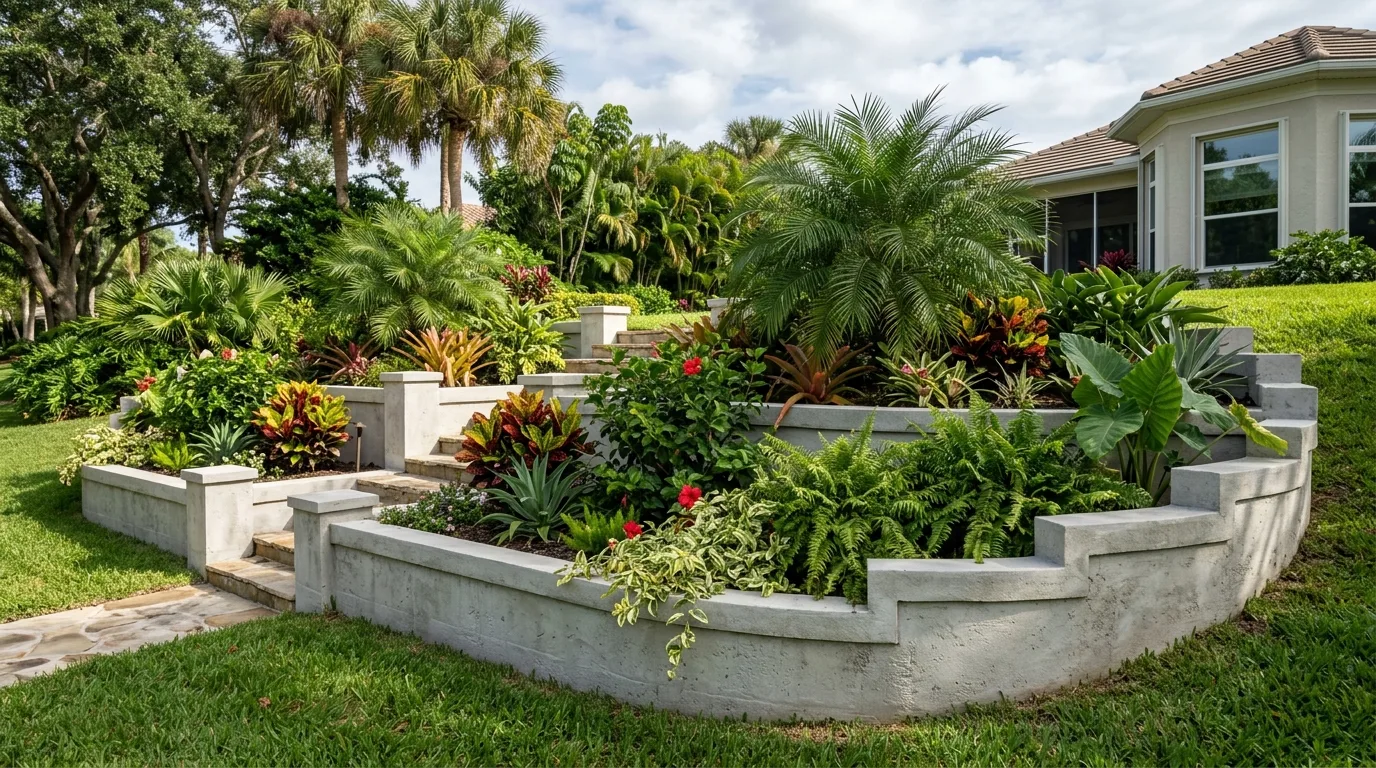
A retaining wall in Largo isn’t just a landscaping feature — it’s a structural element managing soil and water forces that, when those forces aren’t properly contained, damage foundations, cause slope failure, and erode neighboring property. Getting a retaining wall right in Pinellas County’s sandy soil requires understanding both the structural requirements and the drainage design that determines whether the wall performs for decades or fails within a few years.
In this post, we cover the main retaining wall options available to Largo homeowners, when each is appropriate, permit requirements in Pinellas County, and what good retaining wall drainage design looks like in Florida’s climate. Retaining walls connect closely with concrete slab work when creating level outdoor spaces.
Retaining Wall Project in Largo? Call (888) 376-0955
Concrete block and poured concrete retaining walls throughout Pinellas County. Free estimates.
Why Retaining Walls Fail in Largo — and How to Prevent It
The most common cause of retaining wall failure in Largo isn’t the wall material itself — it’s inadequate drainage behind the wall. The same sandy soil conditions covered in our Largo concrete foundations guide affect retaining wall design as well. When saturated soil presses against a retaining wall without relief through properly designed drainage, the hydrostatic pressure that builds up during Largo’s wet season (June through September) can exceed the wall’s structural capacity and cause it to tilt, crack, or collapse entirely.
Pinellas County’s sandy soil actually drains more quickly than clay-based soils, which reduces hydrostatic pressure buildup — but it also means that backfill placement and compaction are critical to prevent voids behind the wall that lead to erosion and settlement. A wall with proper gravel drainage aggregate behind it and drainage outlets through the wall face (weep holes) manages water effectively. A wall without drainage design is depending on luck.
In coastal Largo neighborhoods like Anona and Harbor Bluffs, where properties are closer to the water table and where hurricane-season rainfall can be extreme, drainage design behind retaining walls is particularly critical. We assess drainage conditions on every retaining wall site before recommending materials or design.
Types of Retaining Wall Options for Largo
Concrete Block (CMU) Walls: Concrete masonry unit walls are the workhorse retaining wall system in Largo residential applications — durable, cost-effective, and appropriate for walls under 4 feet in height when properly designed. CMU walls can be left as-is, stuccoed, or faced with stone veneer for a finished appearance. They require grouted cores and appropriate reinforcement for wall heights above 2–3 feet. Cost: $25–$40 per square face foot.
Segmental Retaining Wall Block: Interlocking concrete block systems (similar in appearance to what you see at home improvement stores) are appropriate for lower walls (under 3 feet without engineering) and landscape accent walls. Modular, easier to install in curved or irregular configurations than CMU, and available in a range of textures and colors. Cost: $20–$35 per square face foot.
Poured Concrete Walls: For taller or more heavily loaded retaining applications, poured concrete walls with rebar reinforcement provide the highest structural integrity. Required in some applications under Pinellas County codes. More expensive than block but appropriate for commercial applications, walls supporting structures above them, or walls in high-water-table locations near the Intracoastal. Cost: $35–$55 per square face foot.
Timber Walls: Timber walls (pressure-treated landscape timber or railroad ties) are the most economical retaining option but have a much shorter lifespan in Largo’s humid climate — 10–20 years maximum, compared to 40+ years for concrete. Not recommended for critical retaining applications. Better suited to low ornamental planting bed borders.
Practical Uses for Retaining Walls in Largo
- Level changes in Walsingham or Del Prado yards: Areas of Largo with natural grade variation use retaining walls to create level terrace areas for lawns, patios, and garden beds.
- Preventing erosion near driveways: Sandy soil on sloped areas adjacent to concrete driveways erodes under Largo’s heavy summer rainfall. A retaining wall stabilizes the slope and protects the driveway edge.
- Raised garden beds: Segmental block or CMU walls create functional and attractive raised planting areas throughout Largo residential properties.
- Supporting added fill for pool deck areas: When pool decks are installed on properties that required fill to bring grade up, retaining walls along the property perimeter hold the fill in place.
- Slope stabilization near foundations: When natural or placed soil on a slope threatens to erode toward a foundation, a retaining wall installed at the toe of the slope provides structural protection.
- Landscape definition and hardscaping: Even on relatively flat Pinellas County lots, low retaining walls (12–18 inches) create visual definition between lawn, planting beds, and hardscape areas.
How Retaining Wall Drainage Works in Largo
Every retaining wall design should include: gravel aggregate (3/4” crushed stone) backfilled behind the wall for the full height rather than native sandy soil (which can shift and create pressure); filter fabric between the gravel aggregate and native soil to prevent fine sand particles from migrating into and clogging the drainage aggregate; and drainage outlets (weep holes through CMU walls, or perforated pipe at the wall base) to allow water to exit before hydrostatic pressure builds.
In Largo, we also assess the upslope drainage area — how much water collects above the wall during typical Pinellas County rainfall events — to size the drainage appropriately. A wall with inadequate drainage outlet capacity will still experience pressure buildup during extreme events even if small weep holes are present. Drainage capacity should be designed for the site’s catchment area, not just the wall itself.
For walls taller than 4 feet in Pinellas County, engineering review is typically required. An engineer specifies wall thickness, reinforcement, footing design, and drainage system based on the specific soil conditions and loading at the site.
Retaining Wall Installation Throughout Largo and Pinellas County
Concrete block and poured concrete walls with proper drainage design. Call (888) 376-0955 for a free estimate.
Cost Factors for Retaining Walls in Largo
Retaining wall cost in Largo is quoted per square face foot (wall height × wall length). CMU walls run $25–$40/sqft face; segmental block $20–$35/sqft face; poured concrete $35–$55/sqft face. A 40-foot long, 3-foot tall CMU wall costs $3,000–$4,800 in the current Pinellas County market.
Key cost drivers: wall height (taller walls require more engineering, reinforcement, and footing depth), drainage system design and installation, excavation depth for the footing, and whether the existing grade requires significant cut to create the wall setback. Engineering fees for walls over 4 feet add to total project cost. Pinellas County permit fees for retaining walls depend on height and scope.
Frequently Asked Questions
Do I need a permit for a retaining wall in Largo FL?
Retaining walls over a certain height in Pinellas County require permits and, for taller walls, engineered drawings. The specific permit threshold varies by wall height and whether the wall supports a structure above it. We advise on permit requirements for your specific retaining wall project during the free estimate. Generally: walls under 3 feet may not require permits; walls over 4 feet typically do.
How long does a concrete retaining wall last in Largo?
A properly designed and built concrete or CMU retaining wall in Largo lasts 40–50+ years. The main factors that shorten retaining wall life are inadequate drainage (leading to hydrostatic pressure failure or erosion behind the wall), inadequate footing depth, and insufficient reinforcement for the wall height and loading. Well-built walls in Largo’s climate — which is actually relatively mild on concrete (no freeze-thaw) — are extremely long-lived structures.
What’s the difference between a retaining wall and a garden wall in Largo?
A retaining wall actively holds back soil and manages drainage — it has a structural function. A garden wall defines spaces and adds aesthetic value but doesn’t hold back significant soil loads. In Pinellas County, the distinction matters for permitting and design requirements: structural retaining walls above certain heights need engineering review; decorative garden walls typically don’t. We can advise on which category your project falls into.
Related: